This Philippines internet speed update for November 2026 rounds up the latest independent data on fiber and mobile speeds. It covers which providers lead, how the country ranks, and what it means for your own speed test.
Philippines internet speed update: the headline numbers
| Measure | Result | Source and period |
|---|---|---|
| Median fixed broadband download | 114.34 Mbps (62nd of 149) | Ookla Global Index, August 2026 |
| Median mobile download | 66.33 Mbps (71st of 102) | Ookla Global Index, August 2026 |
| Average broadband download, all ISPs | 108.3 Mbps down / 93.6 Mbps up | SpeedGeo, Oct 2025 – Sep 2026 |
| Average mobile download, all networks | 49.0 Mbps | SpeedGeo, Oct 2025 – Sep 2026 |
The figures differ because each firm uses its own apps, methods and periods. Ookla reports the median, while SpeedGeo reports averages. Even so, both point the same way: fiber in the Philippines now averages around 110 Mbps, while mobile sits around 50 to 66 Mbps.
Fastest broadband providers this year
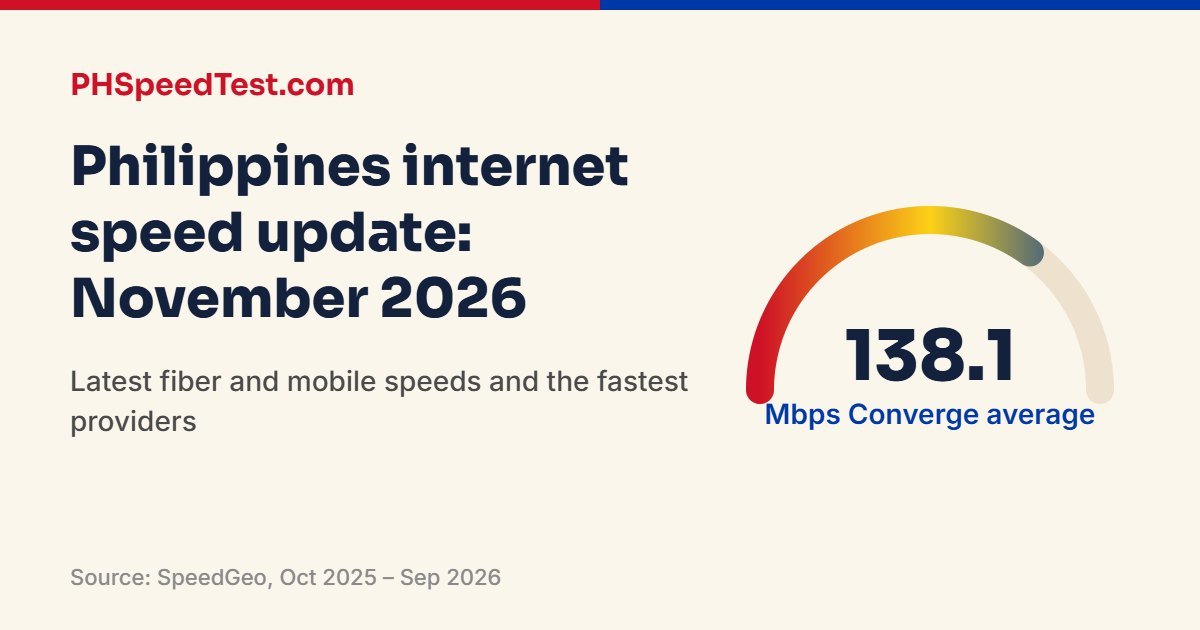
Converge kept its lead across several independent reports. In SpeedGeo’s 12 months to September 2026, Converge averaged 138.1 Mbps down and 125.7 Mbps up, ahead of PLDT and Globe.
| Provider | Download | Upload | Ping |
|---|---|---|---|
| Converge | 138.1 Mbps | 125.7 Mbps | 29 ms |
| PLDT | 116.9 Mbps | 110.4 Mbps | 26 ms |
| Globe | 112.2 Mbps | 91.8 Mbps | 34 ms |
Source: SpeedGeo broadband statistics for the Philippines, 1 October 2025 to 30 September 2026. Note that PLDT recorded the lowest ping in this data.
Other reports agree on the leader. nPerf’s 2026 annual study, covering July 2025 to June 2026, ranked Converge first with an average of 127.39 Mbps down and 117.10 Mbps up. In addition, the DICT’s Oplan Bantay Signal report for Q2 2026 put Converge first for download speed and latency. Ookla also named Converge Best Internet and Fastest Internet for the first half of 2026.
Globe, meanwhile, said its August 2026 results were its strongest of the year so far in DICT data. Read our full comparison of the fastest internet provider in the Philippines.
Fastest mobile network
On mobile, DITO led SpeedGeo’s 12-month data with an average download of 67.2 Mbps, while Smart had the highest upload speed at 10.3 Mbps. This matches recent Opensignal reports, where DITO has repeatedly been the fastest network. See the full fastest mobile network guide.
Six years of progress
An October 2026 analysis of 5.3 million tests from SpeedGeo and related apps found that average fixed download speed rose nearly eightfold, from 14 Mbps in 2020 to 109 Mbps in 2026. Globe improved the most over that period, from 8 Mbps to 116 Mbps. However, the same study warned that outdated WiFi equipment still holds many users back.
That fits what the DICT has said this year: speed is no longer the main problem, while stability and consistency are. So if your result swings a lot between tests, focus on your WiFi and router first. Our guide on how to fix slow WiFi walks you through it.
What this means for your speed test
- If you are on fiber and get below 50 Mbps on a cable, you are well under the national average. Report it to your provider.
- If you get far less on WiFi than on a cable, the router or its location is the bottleneck.
- On mobile, 30 to 70 Mbps is normal in most cities; 5G can be much faster near a cell site.
Check where you stand with the PH speed test, then compare with the national figures in our guide to internet speed in the Philippines. We will publish the next Philippines internet speed update when new monthly data arrives.
Sources: Ookla Speedtest Global Index – Philippines; SpeedGeo – Internet Speed in Philippines; nPerf annual report 2026; DICT Oplan Bantay Signal, Q2 2026; Ookla Speedtest Intelligence, H1 2026.