How fast is internet speed in the Philippines today? This guide brings together the latest Ookla and DICT figures, and shows you how to compare your own result with them.
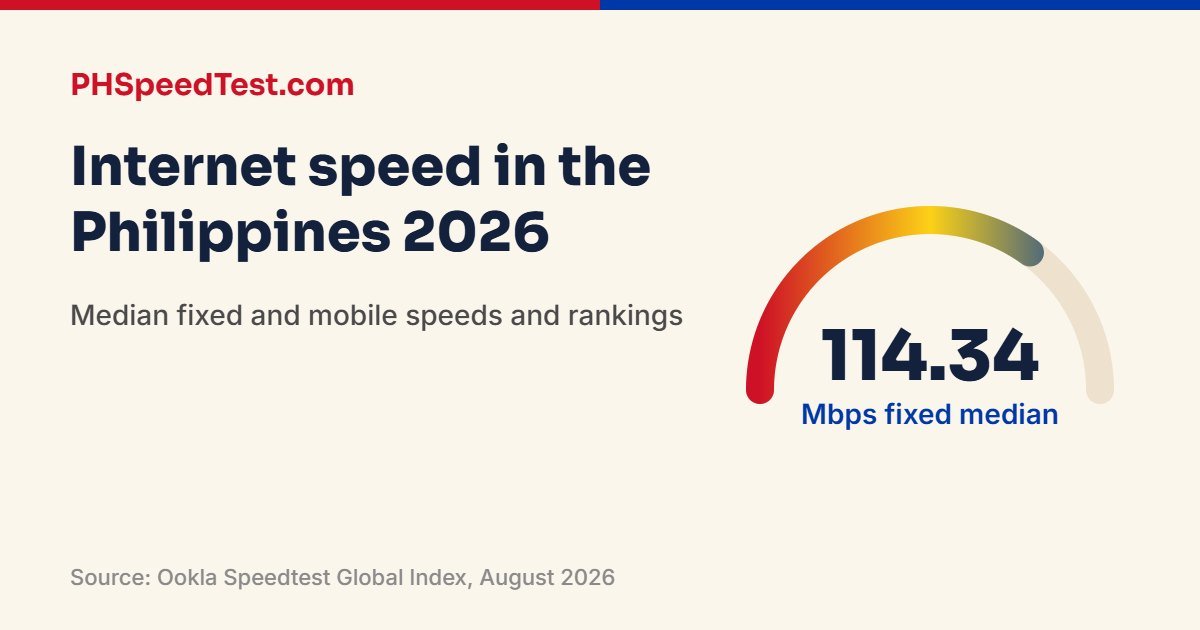
Internet speed in the Philippines at a glance
| Measure | Median download | Source and period |
|---|---|---|
| Fixed broadband (all providers) | 114.34 Mbps | Ookla Speedtest Global Index, August 2026 |
| Mobile (all networks) | 66.33 Mbps | Ookla Speedtest Global Index, August 2026 |
| Fiber | 108.94 Mbps | DICT and Ookla, Q1 2026 |
| Metro Manila mobile | 75.57 Mbps | Ookla, Q2 2026 |
| Cebu mobile | 55.48 Mbps | Ookla, Q2 2026 |
A median means half of all tests were faster and half were slower. That makes it a better picture of a typical user than an average, which a few very fast lines can pull up.
How the Philippines ranks
In Ookla’s August 2026 index, the Philippines placed 62nd of 149 markets for fixed broadband and 71st of 102 for mobile. Both medians are still below the global medians of 129.68 Mbps (fixed) and 109.05 Mbps (mobile).
However, progress has been fast. According to a DICT and Ookla case study, the median mobile download speed rose from 25.29 Mbps in Q1 2023 to 43.80 Mbps in Q1 2026, an increase of about 73%. Over the same period, median fiber speed grew from 89.58 Mbps to 108.94 Mbps.
Internet speed in the Philippines by region
Speeds are not even across the islands. In Ookla’s Q2 2024 regional data, Calabarzon had the fastest median fixed download at 99.55 Mbps, while Eastern Visayas had the slowest at 38.43 Mbps. Luzon generally leads, because most fiber investment has gone into Metro Manila and nearby provinces.
So if you live outside Luzon, a lower result than the national median is common. Compare your result with your plan, not only with the national figure.
Fiber, mobile or Starlink?
- Fiber gives the most stable speed and the lowest ping for most homes.
- Mobile data and 5G can be very fast in cities, but speed changes with signal and crowding.
- Starlink reaches remote islands, but Ookla measured a median of about 55 Mbps in the Philippines in 2026, well below fiber.
How to compare your speed
- Run the speed test three times, including once in the evening.
- Compare a cable result with the fixed median, and a phone result with the mobile median.
- If you are far below both your plan and the median, read why your internet is slow.
To see which providers lead, read our guides to the fastest internet provider and the fastest mobile network in the Philippines.
Sources: Ookla Speedtest Global Index – Philippines; DICT and Ookla case study (Q1 2023 – Q1 2026); Ookla Speedtest Intelligence regional data.